
From 1 December 2026, heat stress measures that were only recommended become mandatory for employers of outdoor workers in Singapore. The Ministry of Manpower (MOM) announced on 28 August 2026 that four practices move from "recommended" to "required": a heat stress training programme, cool drinking water near work areas, cold water, ice packs or water spray on standby, and suitable clothing. If your staff work outdoors (landscaping, renovation, event set-up, loading and construction trades), you have until Monday 30 November to put them in place and be able to show it.
For most small crews the four are simple to provide. What catches firms out is proof: who was trained, where the water is, what is in the emergency kit and who checks the temperature.
At a glance
- 28 August 2026: MOM announces the enhanced Heat Stress Management Framework and gives employers three months to prepare.
- 1 December 2026: training, cool drinking water, emergency cooling supplies and suitable clothing become mandatory requirements.
- New recommended practice: shaded rest areas that are well ventilated and well insulated or cooled.
- Already required: hourly Wet Bulb Globe Temperature (WBGT) monitoring, acclimatisation over at least 7 days, regular hydration, rest under shade and an emergency response plan.
- At WBGT 32°C and above: a continuous paid rest break of at least 10 minutes every hour for heavy physical work.
- Enforcement: MOM's FAQs say failure can lead to action under the Workplace Safety and Health (WSH) Act, including stop-work orders and composition fines.
What changes on 1 December 2026?
MOM's heat stress measures page defines outdoor work as work done primarily in the open without permanent shade, and lists measures by WBGT band. The four new requirements, as MOM's FAQs explain them:
- Heat stress training. It can be run in-house but must cover at least four topics: early signs and symptoms of heat stress; risk factors (worker, task and environment); the heat measures specific to your workplace; and your emergency procedures. MOM recommends a full session every year and before a worker is first sent into hot conditions.
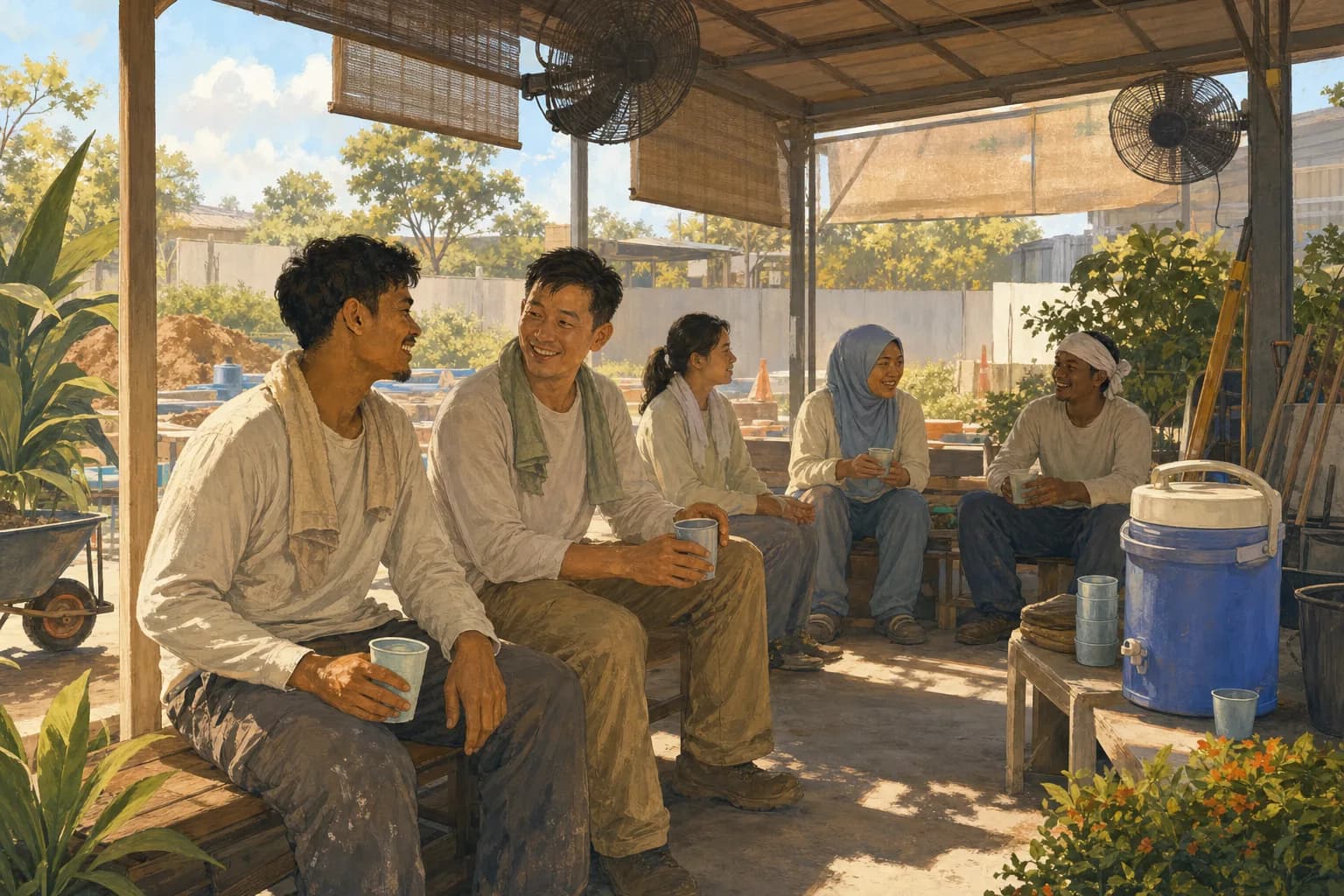
- Cool drinking water near work areas. Water coolers, chilled dispensers, or drinking water in insulated containers all count. Where chilling is not possible, MOM says water should at least be stored in the shade, away from direct sunlight and heat sources. MOM's guide distance is no more than 3 to 5 minutes' walk from where people work.
- Emergency cooling on standby. Enough cold water, ice packs or water spray to actively cool at least one affected worker for several minutes while waiting for emergency services. Instant chemical ice packs do not replace ice; they can only supplement it.
- Suitable clothing. Loose-fitting, breathable or moisture-wicking. You can supply it, pay a clothing allowance or let workers wear suitable clothing they already own. Workers who must wear protective clothing for other safety reasons, such as fire-retardant suits, may be exempted.
How do the WBGT bands work for a small firm?
MOM's FAQs explain that WBGT reflects humidity, wind speed and solar radiation as well as air temperature, so it tracks heat stress better than a thermometer alone. MOM requires on-site WBGT meters only for construction sites with a contract sum of S$5 million or more, shipyards and the process industry. Other workplaces can use the WBGT reading in the National Environment Agency's myENV app, checked every hour during work hours.
The bands on MOM's page and its infographic (PDF):
- Below 31°C: acclimatise new or returning workers over at least 7 days, keep water near work areas, ensure rest under shade, have an emergency plan, identify vulnerable workers.
- 31°C to below 33°C: workers rehydrate at least hourly, with a recommended 300ml an hour or more depending on effort; reschedule heavy outdoor work to cooler hours where feasible. From 32°C, give hourly rest breaks of at least 10 minutes for heavy physical work.
- 33°C and above: MOM's page lists hourly rest breaks of at least 15 minutes for heavy physical work, longer as WBGT rises, and redeploying vulnerable workers to non-outdoor work. The FAQs call the 10-minute hourly break from 32°C a requirement and longer breaks at higher readings recommended, and the page does not label the 15-minute row a requirement.
Three rules from the FAQs matter for rosters. The rest break must be continuous, so two five-minute pauses do not count. You cannot bank breaks, for example 20 minutes after 100 minutes of work. And the hourly breaks at 32°C and above are paid working hours, although an existing tea break of 10 minutes or more in that hour already satisfies the rule.
MOM lists workers vulnerable to heat stress as including those above 65, pregnant workers, workers newly assigned to outdoor work or back from more than a week's leave, and those unwell or with chronic conditions. If you deploy them outdoors, MOM says you have a duty to ensure they are fit for it, and should seek their consent and let them consult a doctor.
Worked example: a six-person landscaping crew (illustrative)
A fictional maintenance firm, run by Rahmat, sends six workers out from 9am to 6pm with an hour's lunch, so eight working hours. Each earns a basic salary of S$2,000 a month.
- Water. At MOM's recommended 300ml an hour for hot conditions, one worker drinks at least 2.4 litres over eight hours, so the crew needs at least 14.4 litres a day. Rahmat buys two insulated 10-litre containers and refills them at lunch (our suggestion, not an MOM rule), placed at the van, which is under three minutes' walk from each work zone.
- Rest time on a hot afternoon. Suppose myENV shows 32°C from 1pm to 5pm, after lunch, and the work is heavy. Each worker takes four continuous 10-minute breaks, or 40 minutes; the crew loses 240 minutes, four crew-hours, of output.
- What that time is worth. MOM's hourly basic rate formula is (12 × monthly basic) ÷ (52 × 44): 24,000 ÷ 2,288 = S$10.49 an hour. Forty minutes is about S$6.99 per worker, or about S$41.96 for the crew. It is paid time, not extra wages, but price it into quotes for afternoon jobs.
- At 33°C or more the listed break rises to 15 minutes an hour: one hour per worker over the same four hours, six crew-hours, worth about S$62.94 at these rates. Moving the heaviest tasks to the morning is usually cheaper.
Our free overtime pay calculator shows the same hourly rate step for your own figures.
What happens if a worker falls ill from heat?
MOM's FAQs say employers and doctors must report occupational diseases caused by excessive heat through WSH incident reporting, and an employee whose illness arises out of and in the course of employment can claim under the Work Injury Compensation Act (WICA). That is one more reason to confirm every outdoor worker is on your WICA policy; our guide to checking WICA insurance coverage walks through it.
If a worker is drowsy or unconscious, MOM says call 995. If they are alert, move them to a cool, shaded, ventilated place, give cold fluids, remove excess clothing and apply ice packs, cold water or wet towels.
Checklist to finish before 30 November
Tick each line with a date in your safety file:
- List every person who works outdoors and mark tasks that are heavy physical work.
- Decide your WBGT source (meter if your sector needs one, otherwise myENV), name who checks it hourly and keep a simple log.
- Write a short in-house training session covering MOM's four topics, run it before 1 December and record attendance and date.
- Place cool water within 3 to 5 minutes' walk of each work area and name who refills it.
- Pack an emergency cooling kit per site: cold water, real ice packs or a spray, enough to cool one worker for several minutes, plus who calls 995.
- Choose how clothing is provided (supplied, allowance or own) and write it down, noting any protective-clothing exemptions.
- Set the rest-break rule for 32°C and 33°C, continuous and paid, with shade nearby.
- Plan 7-day acclimatisation for new or returning workers and a redeployment option for vulnerable staff.
Turning this into a one-page procedure people actually follow is easier with our guide to writing a handover a colleague can use. If heat stoppages could delay customer jobs, add them to your one-page continuity plan. More employer routines are under operations.
Common questions
When do the new heat stress requirements start in Singapore?
On 1 December 2026. From then, training, cool drinking water near work areas, emergency cooling supplies and suitable clothing are mandatory for outdoor work, on top of existing measures such as hourly WBGT checks.
Do I need to buy a WBGT meter?
Only construction sites with a contract sum of S$5 million or more, shipyards and the process industry must have one on site. Other workplaces can use the WBGT reading in NEA's myENV app, checked hourly.
Are heat stress rest breaks paid?
Yes. MOM's FAQs say the hourly breaks at WBGT 32°C and above count as paid working hours, and an existing tea break of 10 minutes or more in that hour already meets the rule.
Can heat stress training be done in-house?
Yes, as long as it covers early signs and symptoms, risk factors, your workplace's measures and your emergency procedures. MOM recommends it yearly and before workers first go into hot conditions.
Sources
- announced on 28 August 2026 mom.gov.sg
- heat stress measures page mom.gov.sg
- FAQs mom.gov.sg
- infographic (PDF) mom.gov.sg
- hourly basic rate formula mom.gov.sg
Something changed or worth adding?
Send a correction or suggestion

